
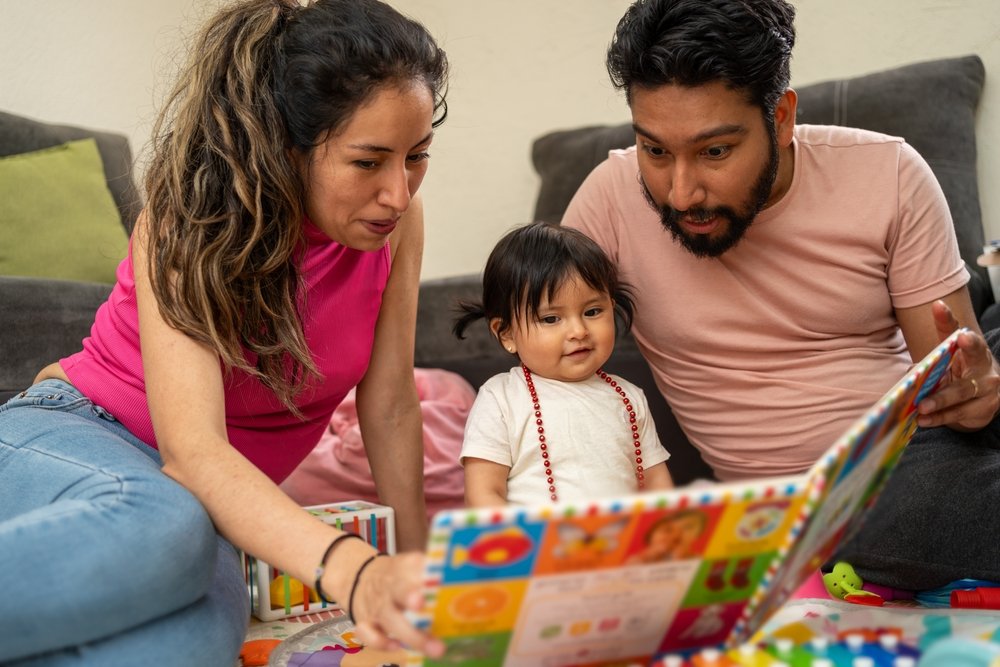
I have been learning Italian for 243 days via Duolingo. I am not great at it and my mouth struggles to make the sounds that even Italian toddlers can produce. I find it frustrating and yet, there is something so fascinating about trying to learn something new as an adult that would have been effortless as a child. That got me thinking about all of the bilingual and multilingual little ones I work with.
Approximately one-third of the infant and young child population in the United States consists of children from dual – or multi – linguistic families. That’s over 7 million children who have access to more than one language. Of those, around 65-70% or more have at least one immigrant parent – around 5 million children, aged 5 and under. And yet, our early childhood educational systems are often not set up to support these children in successfully and fully accessing each of their languages. Instead, these children are frequently—though not universally—placed in English-only early learning environments. Consequently, they encounter significant hurdles to mastering complete conversational, grammatical, syntactical, and literacy skills in all of their languages, which can put them at a distinct disadvantage.
This is not to suggest that early childhood educational settings are at fault. I honestly believe that most are doing their very best to support young children with the tools they have while navigating high turnover, low pay, following curriculums/pedagogies, adhering to state regulations and health and safety requirements, supporting the social and emotional well-being of children, supporting and communicating with families, educator stress and burnout, and financial burdens. And now we want to address the challenge of adding high-fidelity dual language programs? It can seem an impossible task that needs so much more than just a blog post.
That said, given the vast number (and growing) of children in the United States who are working to access more than one language, we must take steps to support this large portion of our population, which, in turn, could vastly benefit the English-only speaking children by giving them access to multiple languages. The European Union has a “Mother Tongue Plus 2” policy in order to support multiliingualism in all of their citizens. In the United States, unfortunately, many myths regarding dual language learners still exist, including the idea that more than one language can cause confusion and delays in the child. In fact, studies have shown that children who have full access to more than one language may have higher executive functioning skills, better problem-solving skills, as well as increased cognitive abilities.
Young children are uniquely primed for learning language and, in a rich language environment with native speakers, can learn 2-3 languages fluently; in some cases even more. This does not mean we should rush to “download” several languages into our children, but if they have the opportunity to be exposed to the multi-faceted aspects of more than one language at an early (typically before 8 years of age) through human connection and education, their brains have the capacity to absorb them.
In fact, in 1944, after spending years observing children in India switching between languages and dialects easily, Dr. Maria Montessori coined the term “the absorbent mind” to describe the child’s ability to absorb information with minimal effort. Through brain science, we now call this neural plasticity, which is at its peak in infancy and early childhood. While we still have the capacity to learn languages later, young children are uniquely capable of absorbing this with little effort.
The challenge lies in implementing programs with fidelity that are actually simultaneously teaching children in their home language and English. Add to this that many of the approximately 5 million children who have immigrant-origin parents are facing additional barriers, such as low income, enforcement fears (which can lead a family to keep their child from school), emotional distress, and communication barriers between families and the schools. Even the idea of considering how to approach this problem is overwhelming.
And yet, it is necessary. A third of our young children are not getting the support they need to communicate effectively with their peers and their families, and they are often not supported in the academic engagement of their home language. We must think deeply about how to not only advocate, but be solution-oriented for these young minds. It can only benefit our country to have a third or more of the population grow up to be well adjusted adults who can communicate fully with others.
Think deeply and share suggestions! Until then, arrivederci!
~Courtney

Leave a Reply